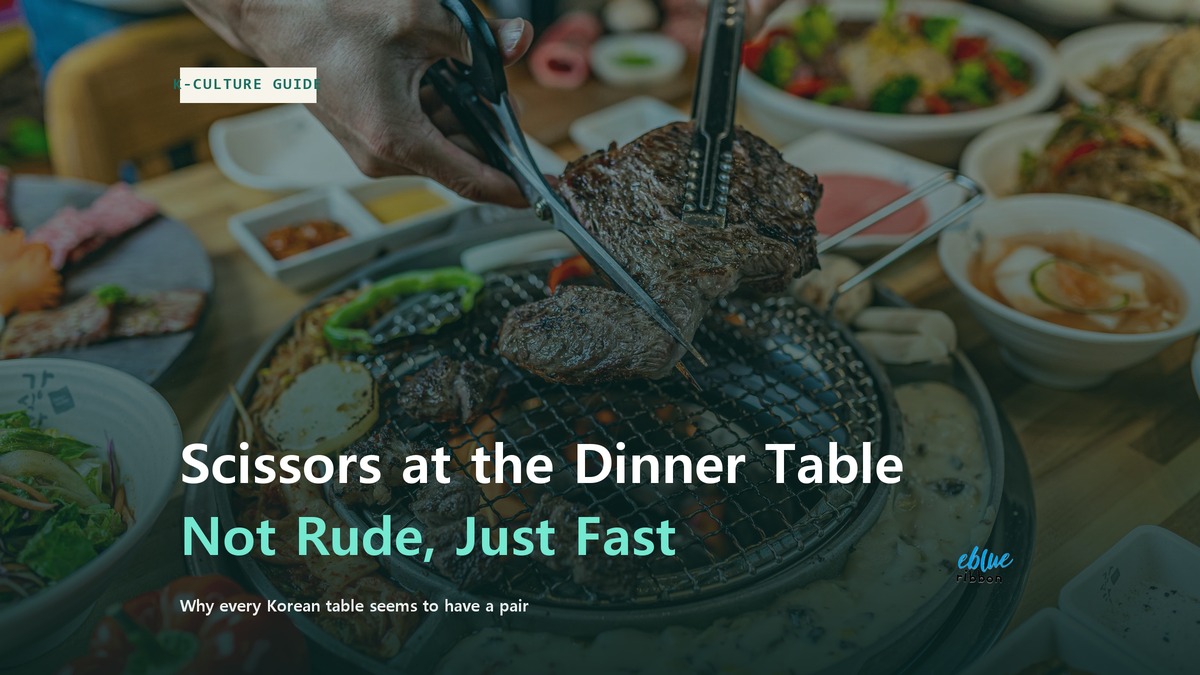

If you’ve eaten at a Korean restaurant, you’ve probably seen a pair of kitchen scissors sitting right next to the chopsticks. Scissors at the dinner table are not a novelty item in Korea — they’re the fastest way to cut noodles, meat, and kimchi without dragging out a knife or a cutting board, and the habit has a specific starting point in the 1970s.
The History Behind Scissors at the Dinner Table
Table scissors trace back to naengmyeon (cold buckwheat noodle) restaurants in the 1970s. Someone working the counter figured out that scissors cut through the long, springy noodle strands far faster than trying to bite off a manageable length with chopsticks, which usually ended with broth splashed across the table. That one fix at noodle shops turned out to be so useful it didn’t stay in noodle shops for long.
How the Habit Spread Beyond Noodle Shops
- By the 1980s and 90s, Korean BBQ spots picked up scissors to portion grilled meat table-side.
- Restaurants serving ox bone soup, kalguksu (knife-cut noodle soup), and stews followed for the same reason — faster than a knife, no extra plate needed.
- Home kitchens adopted them too, for cutting kimchi, dried seafood, and scallions straight into the dish.
The contrast with neighboring food cultures is part of why this stands out to visitors. In Japan, China, and North Korea, long noodles are often left uncut on purpose because they’re tied to ideas of longevity. If you want to see how table roles divide up at a Korean BBQ spot in general — who orders, who grills, who cuts — this guide to ordering at Korean BBQ covers the full picture.
Why Koreans Still Reach for Scissors When They Eat
The practical case for scissors hasn’t really changed since the 1970s. A knife needs a cutting board and a flat surface to press against; scissors work directly over a bowl, a grill plate, or a shared dish, which matters a lot when meals are served family-style in the middle of the table.

Noodles, Meat, and Kimchi: One Tool, Three Jobs
- Noodles: Naengmyeon and japchae strands are elastic and chewy, so a quick cross-cut keeps a bite from turning into a tug-of-war.
- Grilled meat: At a Korean BBQ table, scissors cut galbi or samgyeopsal into pieces sized to fit a lettuce wrap, right after it comes off the grill.
- Kimchi and banchan: Whole cabbage kimchi is often snipped into bite-sized pieces at the table instead of being pre-cut in the kitchen.
For a broader sense of what else shows up on a Korean table alongside these dishes, this Korean street food guide is a useful next stop, since several of the same foods — squid, tteokbokki, noodles — get the scissors treatment on the street too.
Why Not Just Use a Knife?
A knife works fine on a plate in front of one diner. It works less well on a communal grill plate or inside a shared bowl of soup, where there’s no room to saw back and forth. Scissors let one person — often the server or the most senior diner at the table — cut food quickly without disturbing everyone else’s plates.
Is This True at Every Korean Restaurant?
Not quite everywhere. Scissors are close to universal at Korean BBQ restaurants, naengmyeon and kalguksu shops, and casual stew houses. They’re far less common at rice-bowl-only spots, western-style Korean cafes, or formal hanjeongsik (multi-course set meal) restaurants, where food already arrives portioned. If a restaurant serves food that needs cutting and is meant to be shared, scissors are a safe bet to be on the table already.
Common Questions About Table Scissors in Korea
Q. Is it rude to ask for scissors if they’re not already on the table?
A. No — it’s a normal request, especially at BBQ and noodle restaurants. Staff usually bring a pair without being asked once the food that needs cutting arrives.
Q. Are the scissors the same ones used in the kitchen?
A. No, table scissors are a dedicated set kept for food only, usually stainless steel, separate from any kitchen or office scissors.
Q. Should a guest cut the food themselves?
A. At a shared grill or noodle dish, it’s common for staff or the host of the table to do the cutting rather than each guest reaching for the scissors individually.
Curious what else lands on the table alongside the scissors — rice, banchan, soup — before or after the main dish? This guide to what Korean foods go together lays out the usual combinations.
Bring This Up At Your Next Korean Meal
Scissors at the dinner table started as a 1970s fix for noodles that were too stretchy to bite through cleanly, then spread to grilled meat and kimchi because it was simply the fastest tool for food shared at the center of a table. Next time a pair lands next to your chopsticks, you’ll know exactly why it’s there — and you can put it to use instead of waving down a knife. For more on what to expect at a Korean grill table, this Korean fried chicken guide is a good companion read for your next meal out.
#KoreanFoodCulture #ScissorsAtTheTable #KoreanDiningEtiquette #KoreanBBQ #Naengmyeon #KalGuksu #KoreanKitchenHacks #FoodCultureExplained #KoreaTravelTips #KoreanCuisine #EatLikeALocal #KoreanRestaurantTips #FoodHistory #KoreanCulture #BlueRibbonPicks
Leave a Reply