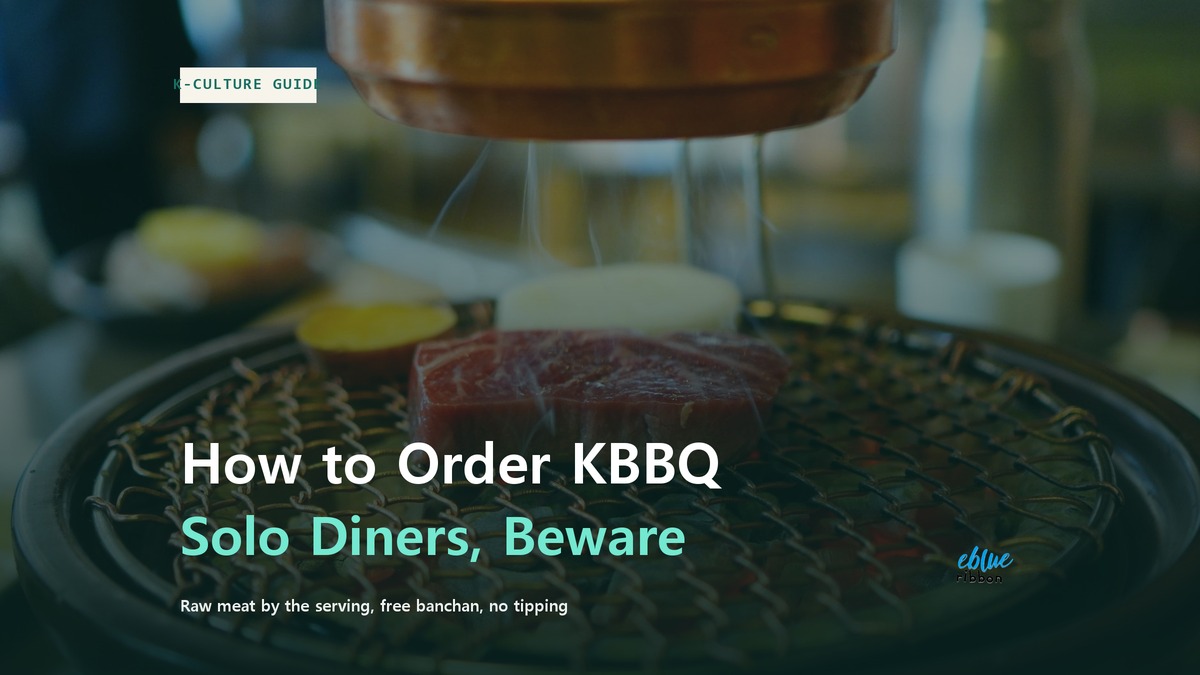

You sit down at a Korean BBQ restaurant, a server drops a stack of small dishes on the table before you’ve said a word, and it’s tempting to assume those are the appetizer. At a Korean BBQ restaurant you order raw meat by the serving (인분, inbun), not a finished dish, and most sit-down restaurants require a minimum of two servings per table before they’ll turn the grill on. Everything else, banchan, rice, the closing course, layers on top of that first decision.
The Two-Step Order: Pick the Cut, Then the Serving Count
Korean BBQ menus split into two decisions that steakhouse habits don’t prepare visitors for. First comes the cut: samgyeopsal (unmarinated pork belly), galbi (marinated short ribs), and bulgogi (thin marinated beef) are the three a first-timer runs into most. Second comes the count, sold in units of inbun, with a single serving landing around 150 to 200 grams of raw meat. Nothing arrives cooked, and nothing arrives seasoned unless the cut itself was marinated.
What One Inbun Actually Gets You
A single inbun rarely fills one adult on its own, which is part of why the two-serving minimum exists at most sit-down restaurants: kitchens and grills are set up around groups splitting several cuts, not one small plate for one guest. A solo diner walking into a traditional Korean BBQ restaurant can be turned away or steered toward a different menu format for exactly this reason.
| Cut | What It Is | Typical Price (per serving) | Good First Order? |
|---|---|---|---|
| Samgyeopsal | Unmarinated pork belly, dipped in sesame oil and salt | ₩14,000–20,000 | Yes, mild and forgiving on the grill |
| Galbi | Soy-and-garlic marinated beef or pork short ribs | ₩20,000–45,000+ | Yes, sweeter and easy to like |
| Bulgogi | Thin-sliced beef in a sweet soy marinade | ₩15,000–25,000 | Yes, needs almost no grilling skill |
A full sit-down meal for two, meat plus banchan plus a closing rice or noodle course, typically lands around ₩60,000–80,000 total before drinks. Some restaurants also run all-you-can-eat formats for roughly ₩18,000–25,000 per person, which flips the math from paying per serving to paying once and refilling the grill as long as you’re still eating.
If the point-and-order rhythm here still feels unfamiliar, the same piece-by-piece logic shows up at street carts, where Korean Street Food: What to Try First and How to Order breaks down naming your order item by item without a shared language.
Banchan Are Free, But Don’t Treat Them Like the Meal
The small dishes that hit the table before anyone has ordered are banchan, and restaurants send anywhere from three to twelve varieties depending on the place, kimchi, pickled radish, seasoned bean sprouts, a simple salad. They’re unlimited and refillable at no extra charge, which catches diners off guard if they’re used to paying per side dish elsewhere. Banchan support the meat rather than replace it, and loading up a plate before the grill has even started is a habit locals notice.
How Much to Take, and When to Ask for More
Use the small tongs or spoon left in each dish to move a modest portion onto your own plate rather than eating straight from the shared bowl. If a dish runs low, catching a server’s eye or pressing the call button built into many Korean BBQ tables gets a free refill; nothing extra shows up on the check for asking twice.
Banchan variety is also where a lot of first Korean meals go sideways for a similar reason fried chicken orders do. Korean Fried Chicken Explained: Why It’s Different and What to Order covers a matching too-many-good-options problem on a menu that looks simple at first glance.
Grilling and Cutting: Who Does It, and How to Wrap a Ssam
At most casual, mid-range Korean BBQ restaurants, the table cooks its own meat, and one person, usually whoever has done this before, unofficially runs the grill: flipping pieces at the right moment and cutting them into bite-sized pieces with kitchen scissors once they’re cooked through. At higher-end restaurants, a server does the grilling and cutting instead, so it’s worth watching for a few seconds before reaching for the tongs.

The One-Bite Rule
A ssam is the wrapped bite that turns grilled meat into a full mouthful: hold a lettuce or perilla leaf flat in one hand, place a cut piece of meat on it, add a small smear of ssamjang (a reddish-brown soybean-chili paste) or sesame oil with salt, then fold the leaf around everything and eat it in a single bite.
- Keep the filling to about one bite’s worth; overstuffing makes the wrap fall apart before it reaches your mouth.
- Half-biting a ssam and setting it back down is considered impolite at the table.
- Grilled garlic and chili slices go inside the wrap too, if you want them.
If cutting your own meat table-side feels like a lot for a first meal, easing in with something lower-effort is a reasonable start, and Korean Convenience Store Food: What to Try First covers grab-and-go options with none of the grill-master pressure.
When the Bill Comes, and Why No One Tips
Korea doesn’t run on tipping. Restaurants, taxis, and salons all pay staff a fixed wage, and leaving extra cash on the table is more likely to confuse a server than please them. A small number of upscale or hotel-style Korean BBQ restaurants add a 봉사료 (bongsaryo), a roughly 10 percent service charge, but it’s built into the printed total rather than something you calculate yourself. Check the bottom of the menu or the receipt to see if it’s already there.
The check itself doesn’t arrive automatically the way it might elsewhere. You ask for it, either by saying 계산해 주세요 (gyesanhae juseyo, please total the bill) to a passing server or by pressing the same call button used for banchan refills, then pay at the register near the door rather than at the table.
One Thing Left on the Pan
Once the meat’s gone, the grill or hot plate usually isn’t done working. Many restaurants offer to turn the rendered fat and scraps left behind into bokkeumbap, fried rice stirred right into the same pan with rice, gim (dried seaweed flakes), and sometimes leftover kimchi, cooked until the bottom catches a light char. Asking is as simple as telling a server 밥 볶아 주세요 (bap bokka juseyo, please fry the rice), and it’s treated as the meal’s actual closing course rather than an optional extra.
Once the pan and plates clear, dessert is its own separate stop rather than something ordered at the table, and Bingsu Explained: Korea’s Summer Shaved Ice and What to Order First covers where people actually go for it afterward.
Korean BBQ Ordering FAQ
Q. Do I have to order a minimum of two servings if I’m eating alone?
A. At most traditional sit-down Korean BBQ restaurants, yes, the two-serving minimum applies per table regardless of party size, which is why solo diners are sometimes turned away or pointed toward an all-you-can-eat format instead.
Q. Am I supposed to grill the meat myself?
A. At casual, mid-range restaurants, usually yes, one person at the table takes over the grill and scissors. At higher-end restaurants, a server typically grills and cuts the meat for you, so watch for a moment before reaching for the tongs.
Q. Is it rude to ask for more banchan?
A. No. Banchan refills are free and expected; catching a server’s eye or pressing the table’s call button is the normal way to ask, not an imposition.
Related Reading
Korean Cafe Culture Explained: Why Study Cafes Exist — a much quieter, no-scissors-required side of Korean dining out.
Korean BBQ isn’t the only meal Koreans cook at their own table. Jjigae (stew) and hot pot-style restaurants follow a similar cook-in-front-of-you setup, minus the grill and the scissors, worth trying once the ssam-and-scissors routine here feels familiar.
#KoreanBBQ #HowToOrderKoreanBBQ #Samgyeopsal #Galbi #Banchan #KoreanFoodGuide #KoreanDiningEtiquette #VisitKorea #KoreanCuisine #BlueRibbonPicks
Source: Korea Tourism Organization, Grilled Pork Belly (Samgyeopsal) (confirmed 2026-08-16)
Leave a Reply