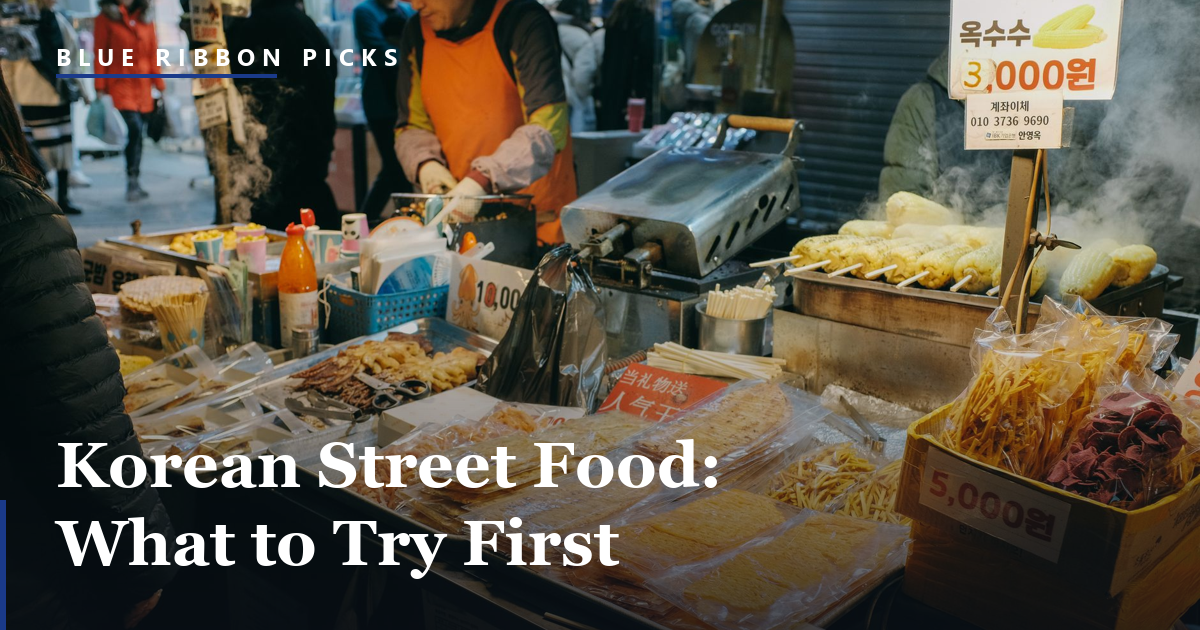

Short answer: start with tteokbokki, hotteok, and a skewer of something fried. Between them they cover the three flavours that define the category, and every one of them is easy to order without speaking the language.
My first attempt at ordering went badly because I hesitated at the front of a queue during the evening rush. The fix was embarrassingly simple: decide what you want while you are still in line, then point.

How ordering actually works
Street food stalls run on speed. Most are operated by one or two people handling a continuous queue, so the interaction is designed to be brief. Knowing this makes it much less intimidating.
Decide before you reach the front, point at what you want, indicate quantity with your fingers, and have payment ready. That covers almost every transaction you will have.
- Decide early — Choose while queuing, not at the counter
- Point — Pointing is normal and expected
- Quantity — Fingers work fine for numbers
- Payment — Card is widely accepted; small cash still helps

The three to start with
If you only try a few things, these cover the range: spicy, sweet, and fried. They are available almost everywhere and they are what the clips you have seen are usually showing.
Spice levels vary considerably between stalls. If you are unsure it is reasonable to ask, and many vendors will offer a milder version or put the sauce on the side.
- Tteokbokki — Chewy rice cakes in a sweet and spicy sauce
- Hotteok — A hot filled pancake, usually sweet
- Fried skewers — Battered and fried, sold by the piece
- Gimbap — Rice rolls, useful when you want something mild
Eating standing up
Most stalls have no seating. There is usually a narrow shelf or counter where you eat, and turnover is fast. This is part of the format rather than a limitation.
A practical detail: sauce gets everywhere. Take napkins before you start rather than after, and expect to need more than you think.
- Standing counters — Eat at the stall rather than walking away with it
- Napkins — Take them before you start
- Bins — Return skewers and cups to the stall
- Sharing — Ordering a few things between two people works well

Markets versus street stalls
There is a meaningful difference between a covered market and a stall on a street corner, and it affects what you should expect.
Markets tend to have more variety, seating in some sections, and longer hours. Street stalls are faster, cheaper, and more likely to specialise in one or two items done well.
- Covered markets — Wide variety, some seating, longer hours
- Street stalls — One or two specialities, faster service
- Night stalls — Appear in the evening in busy districts
- Seasonal — Some items only appear in winter or summer
Why street food dominates short-form
The reason is structural. Cooking at a stall is a visible process with sound, steam, and a clear ending, all happening in a confined frame. It is close to a perfect short-form subject.
It also needs no translation. A viewer who has never heard of the dish still understands what is happening, which is why these clips cross borders more easily than almost any other food content.
- Visible process — The whole thing happens in one shot
- Sound — Sizzling and frying carry the clip
- Speed — Start to finish inside thirty seconds
- No language needed — Understandable anywhere
Practical points for visitors
A few things worth knowing before you go, particularly if you have dietary requirements or are travelling with others.
Communicating allergies reliably is difficult at a busy stall. If you have a serious allergy, a written note in Korean is far more dependable than trying to explain in the moment.
- Allergies — Carry a written note in Korean if it is serious
- Vegetarian — Harder than expected; broths often contain fish or meat
- Hygiene — Busy stalls with high turnover are generally a good sign
- Timing — Late afternoon and evening are when most stalls operate
Quick comparison
| Item | Flavour | Difficulty for beginners | Note |
|---|---|---|---|
| Tteokbokki | Sweet and spicy | Easy | Spice varies by stall |
| Hotteok | Sweet | Easy | Filling is extremely hot |
| Fried skewers | Savoury | Easy | Sold per piece |
| Gimbap | Mild | Very easy | Good for cautious eaters |
| Sundae | Savoury and distinctive | Harder | An acquired taste for many |
Frequently asked questions
Is street food safe to eat?
Stalls with high turnover and visible cooking are generally a good sign, since food does not sit around. Busy is usually better than quiet.
How spicy is tteokbokki really?
It varies a lot. Some versions are mild and sweet, others are genuinely hot. Asking is reasonable, and many stalls offer a less spicy option.
Can I take it away?
At most stalls you are expected to eat there, partly because of packaging and partly because the food is best immediately. Some will pack it if you ask.
Is it cash only?
Card acceptance is now common, though a small amount of cash is still worth carrying for older markets and smaller stalls.
What if I cannot eat pork or beef?
Say so clearly, but be aware that broths and sauces frequently contain meat or fish products. A written note is the most reliable approach.
Wrapping up
Street food is the easiest possible entry point into Korean food culture. There is no menu to decode, no reservation, and no commitment beyond a few thousand won.
Decide before you reach the front of the queue, point at what you want, and eat it standing at the counter. That is the whole method.
Related reading
You Might Also Like
- Bingsu Explained: Korea’s Summer Shaved Ice and What to Order First
- Korean Fried Chicken Explained: Why It’s Different and What to Order
- Korean Skincare Routines Explained: What the 10 Steps Actually Do
Want these in your inbox? Subscribe below and every new post lands there first.
Leave a Reply